I recently had the occasion of watching the 2020 adaptation of Anton Chekov’s « Uncle Vanya » by director Ian Rickson in which every character struggles with existential anxiety, dissatisfaction and regret. I therefore decided to think about Chekov’s “Uncle Vanya” characters in detail from an existential point of view. The problem of existence is raised since the very beginning of the play with Dr. Astroff’s expression of exhaustion and emptiness in the exercise of his work and existence: “And then, existence is tedious, anyway; it is a senseless, dirty business, this life, and goes heavily. Every one about here is silly, and after living with them for two or three years one grows silly oneself. It is inevitable.” Another issue is raised here, that of boredom, or “silliness”, that comes from the mediocrity of the lives that are led by people in the country. The opposition country/city keeps coming back during the play. Country life could signify the normality, “normal people”, but also what Uncle Vanya spent his life investing, which goes to waste: what “grandeur” could someone expect from the mediocrity of country life?
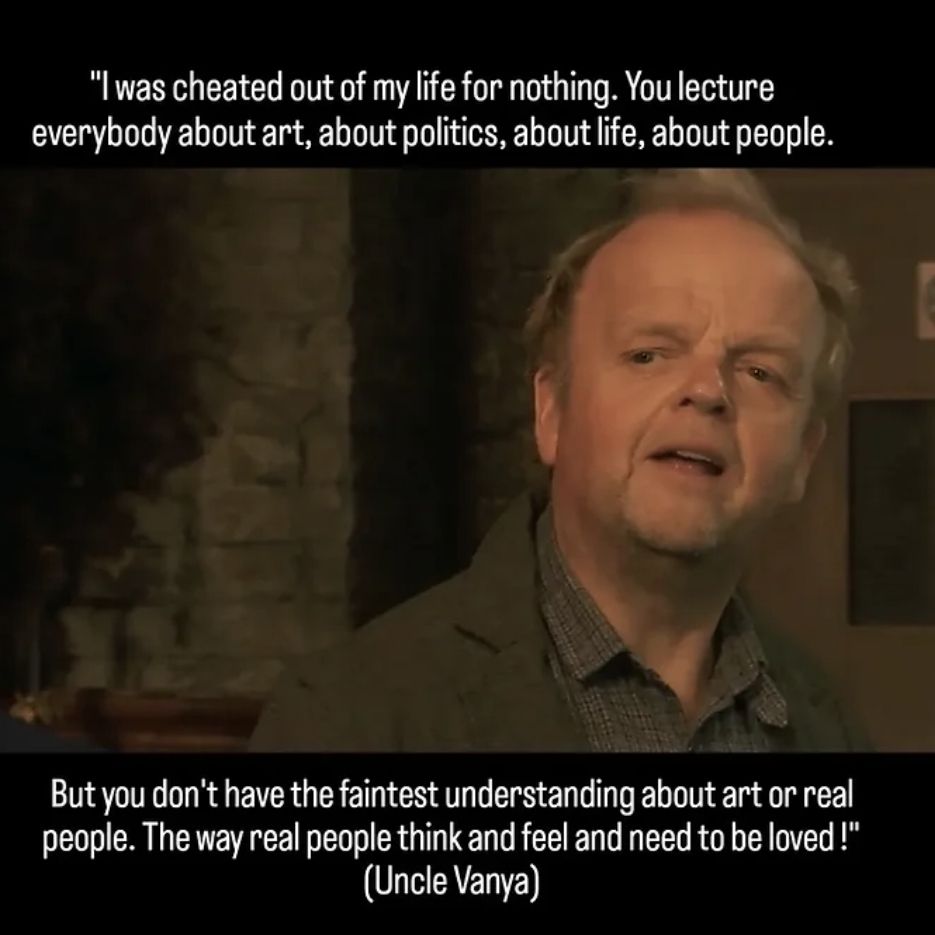
Uncle Vanya (Ivan Voitski): the first appearance of Vanya is when he wakes up suddenly from a nap. This action of waking up might be metaphorical to what happens during the play. Once he wakes up, he declares: “Something is wrong”. During the play, we discover a 47-year-old man who faces the emptiness of having worked and loved in vain: “Until last year I endeavored, as you do now, to blind my eyes by your pedantry to the truths of life. But now-Oh, if you only knew! If you knew how I lie awake at night, heartsick and angry, to think how stupidly I have wasted my time when I might have been winning from life everything which my old age now forbids.” Vanya had spent years quieting his existential dread by throwing the responsibility of his own life on someone else, Pr. Alexander. He tried to succeed through him, and got his greatest disappointment from him. Today, Pr. Alexander represents Vanya’s own wasted existence, he has fallen off the pedestal and the idealization that gave meaning and grandeur to many of those who live around him, including Vanya, is no more valid, he has failed to achieve fame and therefore wasted all the efforts and lives that were allied to his: “I was proud of him and of his learning; I received all his words and writings as inspired, and now? Now he has retired, and what is the total of his life? A blank! He is absolutely unknown, and his fame has burst like a soap-bubble. I have been deceived; I see that now, basely deceived.” Vanya is also a creature devoured by envy, to a point that could’ve led him to murder, what he envies Pr. Alexander is his success with women: in fact, his first wife was Vanya’s sister, whom he adored, his second wife is Helena whom he’s in love with (isn’t there an unelaborated Oedipus complex between Vanya and his sister?). Even his own mother prefers Pr. Alexander to him, and views him as a “demi-god”. At the end of the play, the professor and his wife leave for the city, and Vanya finds himself without his existential crutch, left to face the conscience of the passing of time and of lack of meaning in his own life. Yes, Vanya is awake to a sad but necessary truth. If only he had thought of death before, he might’ve lived better.
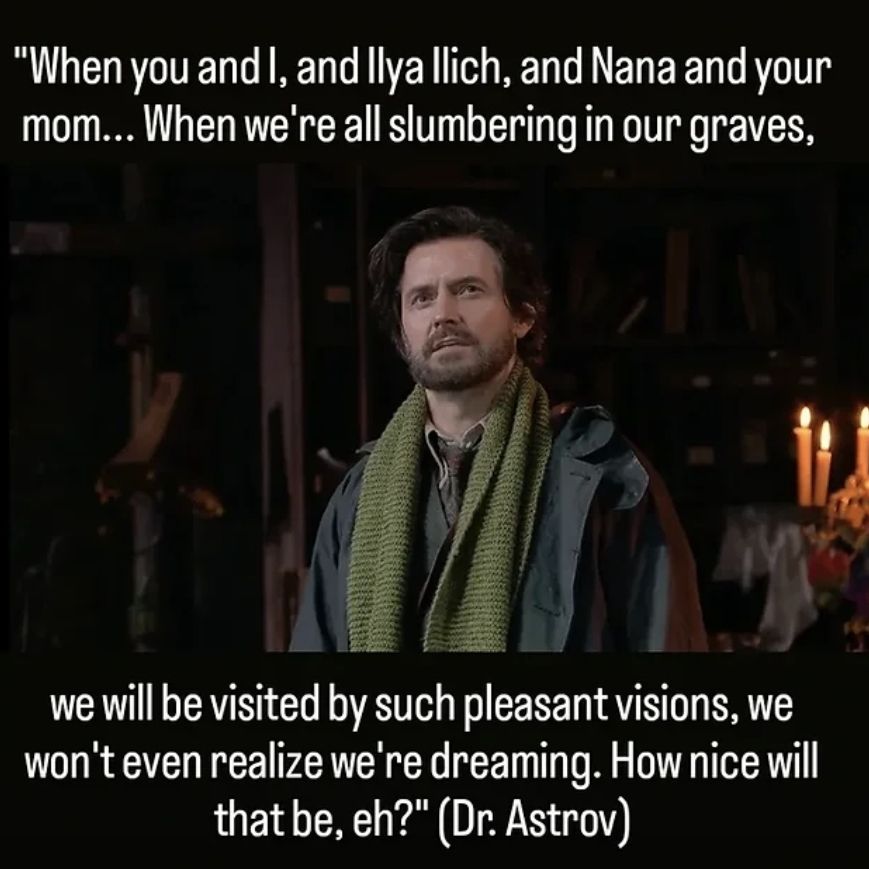
Dr. Michael Astroff: the only character viewed as interesting by others, as having a higher call, a thirst for life and creation (“Man is endowed with reason and the power to create, so that he may increase that which has been given him”) which attracts Sonya and her stepmother, Helena. Dr. Astroff is weighed down by the errors of his past, especially by the death of a patient of his under chloroform. How does he comfort himself? Aside from drinking, there’s a constant idea that he keeps repeating at the beginning and at the end of the play: “I sat down and closed my eyes like this and thought: will our descendants two hundred years from now, for whom we are breaking the road, remember to give us a kind word? No, nurse, they will forget.” To think of it, this idea is both highly disturbing and reassuring. To think of one’s own insignificance can relieve us of the heaviness of our existence, can decenter us from ourselves, from our self-centered natures, but at the same time, it makes what seems important for us, the meanings of our lives, fade away in eternity and time. Dissatisfied with his work as a doctor, he always wants to find another calling, one with which he can be in harmony, with which he could feel satisfied with meaning for his life. He finds this satisfaction in planting forests, trees being his vessels to a future in which he won’t exist: “I feel as if I had had some small share in improving the climate, and that if mankind is happy a thousand years from now I will have been a little bit responsible for their happiness”. Being so self-absorbed, having no respect to ordinary life, even that of Helena to whom he is physically attracted (he recognizes, himself, that he doesn’t have feelings of love or affection for her), Dr. Astroff is unable to love. When Sonya asks him: “You love no one?” He replies: “Not a soul. […] The peasants are all alike; they are stupid and live in dirt, and the educated people are hard to get along with. […] All our good friends are petty and shallow and see no farther that their own noses; in one word, they are dull.”
Helena: married to Pr. Alexander, Helena’s beauty captures many men, including Vanya and Dr. Astroff. Nevertheless, she’s a lonely creature and the attraction men feel towards her weighs her down, she sees in it devaluation and destruction: “Why cannot you look calmly at a woman unless she is yours? Because, the doctor was right, you are all possessed by a devil of destruction; you have no mercy on the woods or the birds or on women or on one another.” Does Vanya love Helena for who she is? He says: “You are my joy, my life, and my youth”, he asks from her: “help me first make peace with myself. My darling!” She responds to Vanya with a feeling of numbness, she feels dead and unable to answer his words: “I am as it were benumbed when you speak to me of your love, and I don’t know how to answer you”. Helena craves something out of the ordinary, an interesting, meaningful and artistic life, yet she hides in the shadow of her husband, accepting her alienation as a fate. Helena likes Dr. Astroff and accepts the disrespect he admitted openly to her only because she perceives him as an exceptional being and because she despises herself: “I am a worthless, futile woman. I have always been futile; in music, in love, in my husband’s house-in a word, in everything. When you come to think of it, Sonia, I am really very, very unhappy.”
Ilia (Waffles) Telegin: Ilia is completely mad when Helena forgets her name and calls him Ivan. Ilia gives meaning to his life through the idea of dignity and that of faithfulness. For these values, he could accept to sacrifice his years: “everyone who betrays husband or wife is faithless, and could also betray his country”. Ilia’s wife left him one day after their wedding, but he remained faithful to her all his life, to the extreme end in which he has given his own fortune “to educate the daughter of herself and her lover.” Ilia doesn’t measure the success and satisfaction of his life by how happy he is, as he says: “I have forfeited my happiness, but I have kept my pride.” Let’s consider the matter from another point of view: didn’t Ilia spend all his life to restore his wounded image of himself? In fact, the reason why his wife left him was simply his appearance, his physique… therefore the idea of pride might come to counter the humiliation he felt back then. What is pride? Isn’t it linked to one’s own narcissism, one’s image in front of others, but most of all, in front of oneself? Does Ilia really love his former wife? Or does he find solace in the comparison of his life to hers, of his pride to her degradation? “And she? Her youth has fled, her beauty has faded according to the laws of nature, and her lover is dead. What has she kept?” Does the consolation of Ilia reside in the failure of his wife?
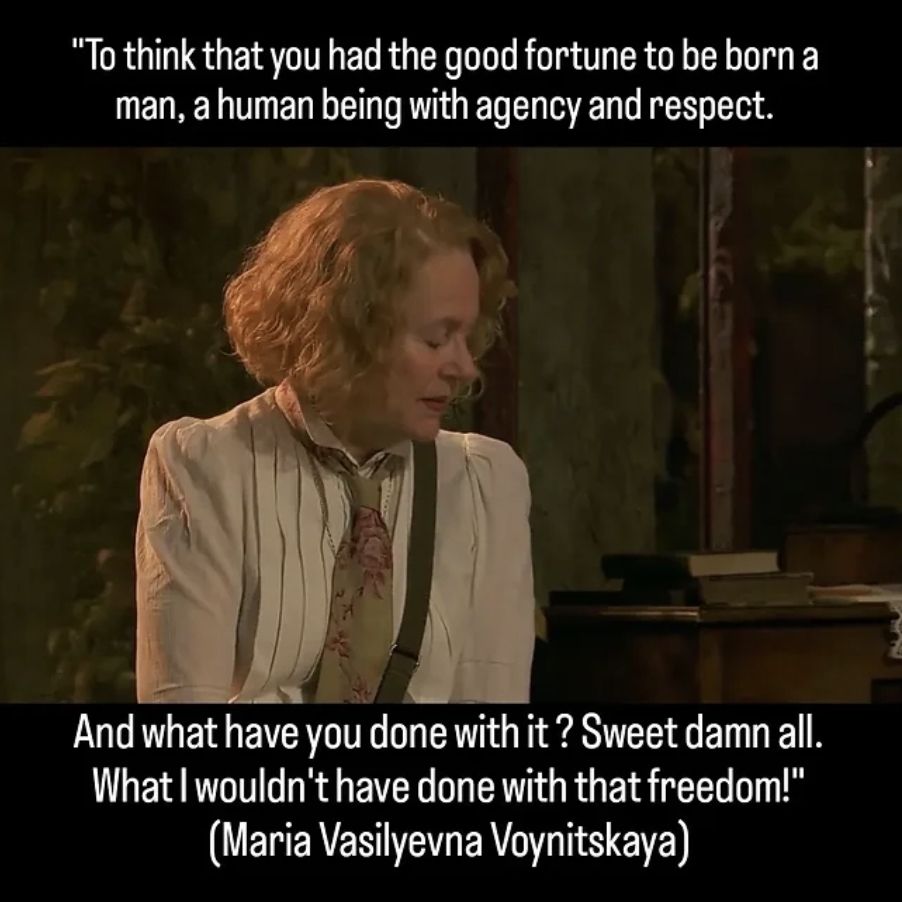
Maria Vasilyevna: Vanya’s mother. She thinks that, as a woman, she can achieve something only by supporting unconditionally a dominant male, Pr. Alexander. This is how Vanya describes her existence: “My mother, the old magpie, is still chattering about the emancipation of woman, with one eye on her grave and the other on her learned books, in which she is always looking for the dawn of a new life.” Yes, Maria Vasilyevna thirsts for a new existence, in which she can get to achieve her ambitions… perhaps as a man. She keeps reminding Vanya of his failure to achieve anything meaningful, which is a reproach that holds a special significance because, being his mother, the one who gave him life, she might be saying in fact that, in the end, he wasn’t deserving of it: “You have forgotten that a conviction, in itself, is nothing but a dead letter. You should have done something.”

Pr. Alexander Serebrakoff: tormented by the idea of his own death, Pr. Alexander tries to achieve immortality through his ideas, and by being adored and obeyed by everyone in the house. Death and castration (dream in which his left leg belongs to someone else) create a deadly alliance to increase the fragility of Pr. Alexander, to which he reacts by a narcissistic dominance on everyone else. Nevertheless, on the opposite side of his psychological and relational tyranny, the body of the professor, who suffers from many ailments (some of them disappear suddenly which makes us think of a psychosomatic origin), expresses his need for attention and his childlike vulnerability. His need for attention manifests itself as well in his constant victimization discourse: “Of course I see that it is foolish for me to live so long, but wait! I shall soon set you all free. My life cannot drag on much longer.” He even justifies himself for being a tyrant: “Even if I am hateful, even if I am a selfish tyrant, haven’t I the right to be one at my age? Haven’t I deserved it? Haven’t I, I ask you, the right to be respected, now that I am old?” Pr. Alexander is conscious of having fallen off the pedestal, and this narcissistic blow is very hard for him to bear: “I long for success and fame and the stir of the world, and here I am in exile!”
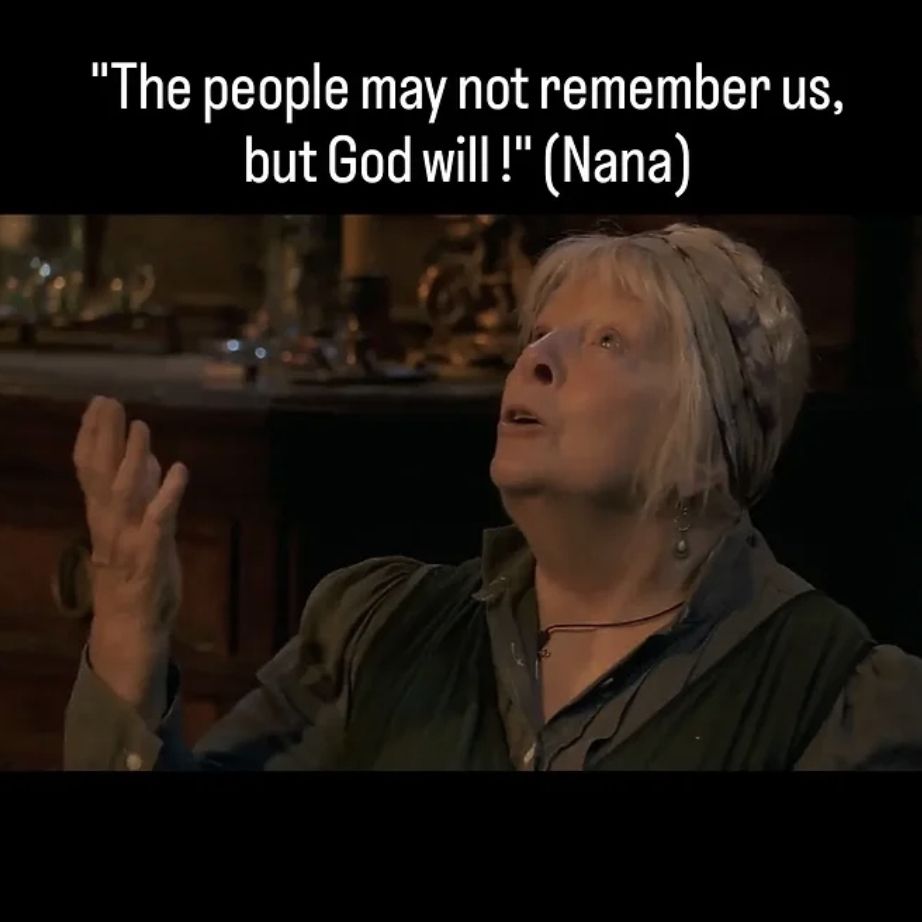
Marina (Nana): Nana, the servant, takes care of everyone in a motherly manner. Her religious faith is a huge consolation to her, on the contrary of Dr. Astroff and Pr. Alexander, she doesn’t seem tormented by the thought of being remembered or leaving an earthly trace. She’s convinced that: “Man is forgetful, but God remembers” even people who lead modest lives, like herself.
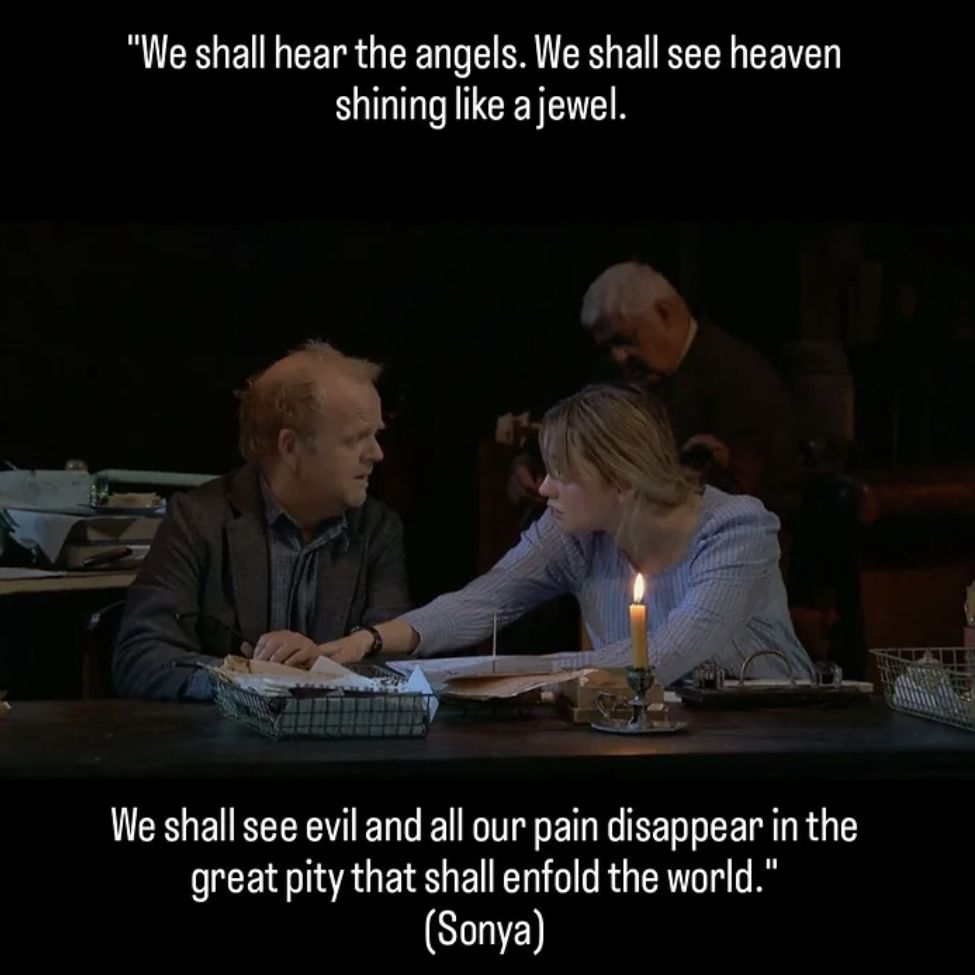
Sonya: Sonya is Vanya’s nephew, the daughter of Pr. Alexander and his former wife, Vanya’s sister. She has an unrequited love for Dr. Astroff. How can she not see his hard-hearted nature? Is it because of his resemblance to her own father? “You are well-bred, your voice is sweet, you are – even more than any one I know- handsome.” Is Sonya blinded by Dr. Astroff’s appearance and passion, which make him uncommon? “Why do you want to resemble the common people that drink and play cards?” she asks him to convince him to stop drinking. Sonya is in contact with reality more than anyone else but in the same time is able to have a constant hope through her faith in life. She believes that someday, endurance will bear fruits, and one will be rewarded: “Give it up, Uncle Vanya! My misfortune is perhaps even greater than yours, but I am not plunged in despair. I endure my sorrow, and shall endure it until my life comes to a natural end. You must endure yours, too.” With these words, she persuades her Uncle Vanya to give away the morphine he had stolen from Dr. Astroff to eventually put an end to his life. Sonya is trying to preserve order where everyone else is losing themselves and neglecting their tasks, she believes in work and perseverance: “Our hay is all cut and rotting in these daily rains, and here you are busy creating illusions! You have given up the farm altogether. I have done all the work alone until I am at the end of my strength.” Sonya has both a stoic and a dreamy nature. She’s the one at the origin of the title of the play « Uncle Vanya », and it is she who has the final word: “You have never known what happiness was, but wait, Uncle Vanya, wait! We shall rest.”
Pamela Hayek
 ivressedesplumes.com
Laisser un commentaire